What Is a Mamianqun? The Horse-Face Skirt Guide (for Women and Men)
The mamianqun, or horse-face skirt, is the Ming dynasty pleated skirt that became hanfu's biggest revival hit. Here's where it comes from, how it's built, how to style it for women and men, and what to look for when you buy one.
If you've scrolled past a pleated skirt with flat front panels and a band of gold weaving at the hem, often worn with a sweater and sneakers, you've seen a mamianqun (马面裙), the "horse-face skirt". It's the most popular piece of hanfu, or traditional Han Chinese clothing, being worn today. It's also one of the easiest to style.
Mamianqun in one paragraph: The mamianqun is a wrap skirt made of two overlapping pieces sewn to one waistband. When it's tied on, a flat, unpleated panel (the mamian, or "horse face") sits at the front and back, with deep pleats at the sides. It took its classic form in the Ming dynasty (1368–1644), stayed in everyday wear through the Qing dynasty, faded in the early twentieth century, and came back with the hanfu revival of the 2000s.
Why is it called a "horse-face" skirt?
Not because of horses. Mamian (马面) was a word for the square towers that jut out from a Chinese city wall at regular intervals. The flat front panel of the skirt, framed by pleats on each side, looks a lot like one of those towers in a long wall, and the name stuck.
Where does the mamianqun come from?
Skirts with an open front and back and pleated sides were already worn in the Song dynasty (960–1279). One early version was called the xuanqun (旋裙, "whirling skirt"). Its split panels made it easy to move in and even ride in. Historians still debate exactly how the Song skirts turned into the Ming one, but by the Ming dynasty the horse-face skirt was standard women's dress.
Ming skirts were fairly plain: big, deep pleats, few of them, and a front panel that was left simple. Decoration went into woven bands called lan (襕) running around the skirt, either one band near the hem or two, one at the knee and one at the hem. Gold-woven lan with dragons, phoenixes, clouds or flowers were a sign of wealth and celebration.
In the Qing dynasty, Han Chinese women kept wearing the skirt, and it became more elaborate: finer pleats, wider waistbands, embroidery on the front panel, and new variations with names like the "phoenix-tail skirt" and "fish-scale skirt". By the 1920s and 30s, Western dress and the new qipao had pushed it out of fashion.
How a mamianqun is built
Lay one flat and you'll see it isn't a tube at all. It's two identical pieces on one waistband:
- Four flat panels (qunmen). Each half has a flat panel at both ends. When you wrap the skirt, two panels overlap at the front and two at the back, so you only ever see two "faces".
- Pleats on the sides. The fabric between the panels is folded into pleats instead of being cut away. That's what lets the skirt move when you walk.
- A separate waistband, usually in a different, plain fabric, tied with ties at the back or side.
- The lan bands: the woven or embroidered borders that make each skirt distinctive.
You put it on by wrapping one half around your waist, then the other half on top so the panels line up, and tying the band. There's no zip and no fixed size, which is part of why it's so popular: one skirt fits a range of waists.
How women wear it today
The classic Ming look. Pair the skirt with an aoqun top, a fitted short jacket with a round or standing collar, or with a longer pao robe over it. Add hair ornaments: gold hairpins, a pearl tiara, velvet flowers or swaying tassels.
The everyday look. The mamianqun's big comeback is as a modern skirt. Wear it with:
- a fine-knit sweater or a plain white shirt
- a short wool coat or a cropped blazer in winter
- ballet flats, loafers or clean sneakers
It works for the office, weddings, travel photos and especially Chinese New Year, when red-and-gold lan bands are everywhere.
Colours to try: crimson and gold for festivals, indigo with cloud patterns, ivory and gold for a softer look, plum or emerald for winter, and black with a single gold band for something modern.
Can men wear a mamianqun?
Historically, the mamianqun was a women's skirt. But the same construction, flat panels with pleated sides, shows up in Ming men's dress too. The yisa (曳撒), a robe worn by Ming officials and guards, has a fitted top and a pleated skirt with a flat front panel, and the tieli (贴里) robe has a pleated lower half.
Today, men in the hanfu community wear both:
- A yisa or tieli robe, the most historically grounded choice: a single robe with a pleated skirt built in.
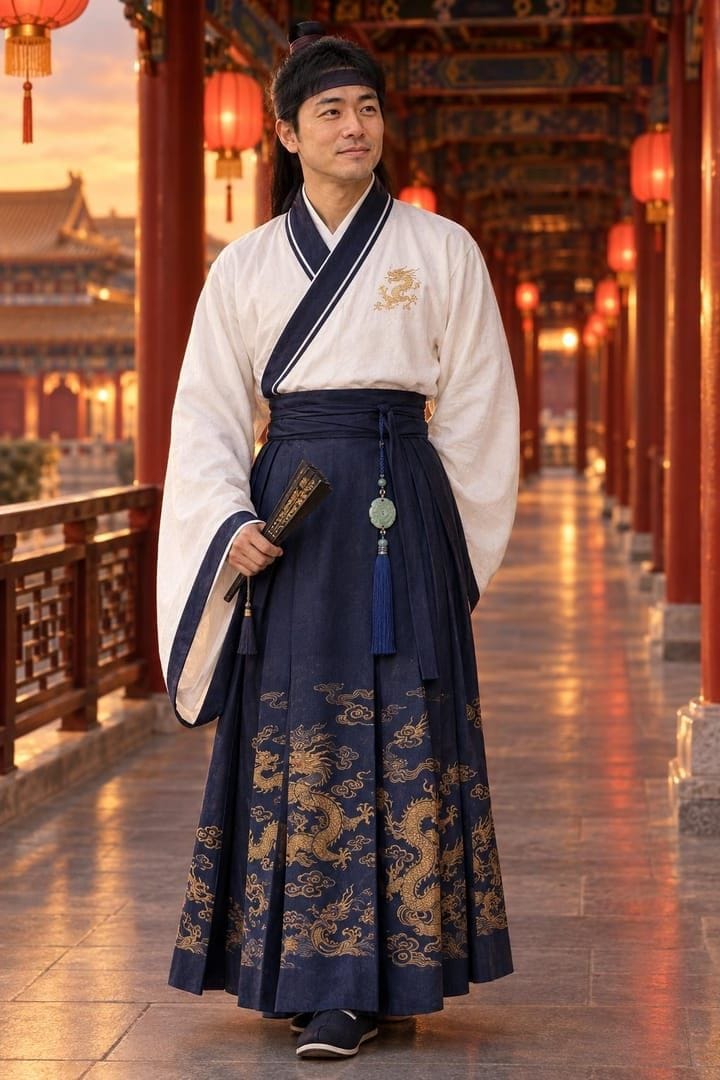
- A mamianqun with a men's jacket, a modern look. Go for darker colours (navy, black, teal) with a dragon or cloud lan, a crossed-collar jacket and a topknot with a jade pin or a scholar's cap.
The portrait at the top of this guide shows the second option: a white jacket over a navy skirt woven with gold dragons.
Buying your first mamianqun
- Woven vs printed. Real zhuanghua or jacquard-woven bands are heavier and richer, and cost more. Printed bands are fine for a first skirt.
- Check the pleats. Good skirts have crisp, evenly pressed pleats that stay put. Cheap ones lose their shape after a wash.
- Length. Traditional skirts reach the ankle. For everyday wear, many people like a mid-calf length so they can wear it with flats.
- Waist. Because it wraps and ties, one size fits a range, but check the waistband length if you're tall or plus-size.
- Care. Hand-wash or dry-clean, hang to dry, and re-press the pleats with a cool iron through a cloth.
The Dior controversy, briefly
In July 2022, Dior released a pleated skirt in its Fall collection that looked very much like a mamianqun, without mentioning the skirt's Chinese origins. It sparked a wave of criticism on Chinese social media and a small protest outside a Dior store in Paris. The episode brought the mamianqun to a much wider audience, inside China and beyond.
Try the look before you buy
A good mamianqun isn't cheap, and it's hard to know which colour suits you from a product photo. Dynasty Portrait turns one selfie into a full-body portrait in a Ming horse-face skirt, with hair ornaments for women, topknot crowns and scholar's caps for men, and a palace, garden or lantern-corridor backdrop. Every portrait is AI-generated, and your selfie is deleted within 24 hours.
Quick answers
How do you pronounce mamianqun? Roughly mah-mee-en-chwin.
Is a mamianqun the same as hanfu? It's one piece of hanfu. Hanfu is the whole family of traditional Han Chinese clothing, and the mamianqun is its most famous skirt.
Can I wear a mamianqun if I'm not Chinese? Yes. It's widely sold and worn as fashion, and the hanfu community generally welcomes interest. Learn what you're wearing, and avoid treating it as a costume joke.
Is it good for Chinese New Year? Very. Red-and-gold skirts are a New Year favourite. See our Chinese New Year 2027 outfit ideas for more.
What's the difference from a pleated skirt? A regular pleated skirt is pleated all the way around. A mamianqun has flat panels at the front and back, wraps instead of zipping, and usually has woven lan bands.
Want to see the look on you? Try the Ming horse-face skirt style, or read about another trending look, the Xunpu flower crown.