What Is Zanhua? The Xunpu Flower Crown, Explained
Zanhua is the custom of wearing flowers in the hair, and in Xunpu, a fishing village in Quanzhou, it became the zanhuawei — a full halo of blossoms around a low bun. Here's where it comes from, what it means, how it's made and how to try it.
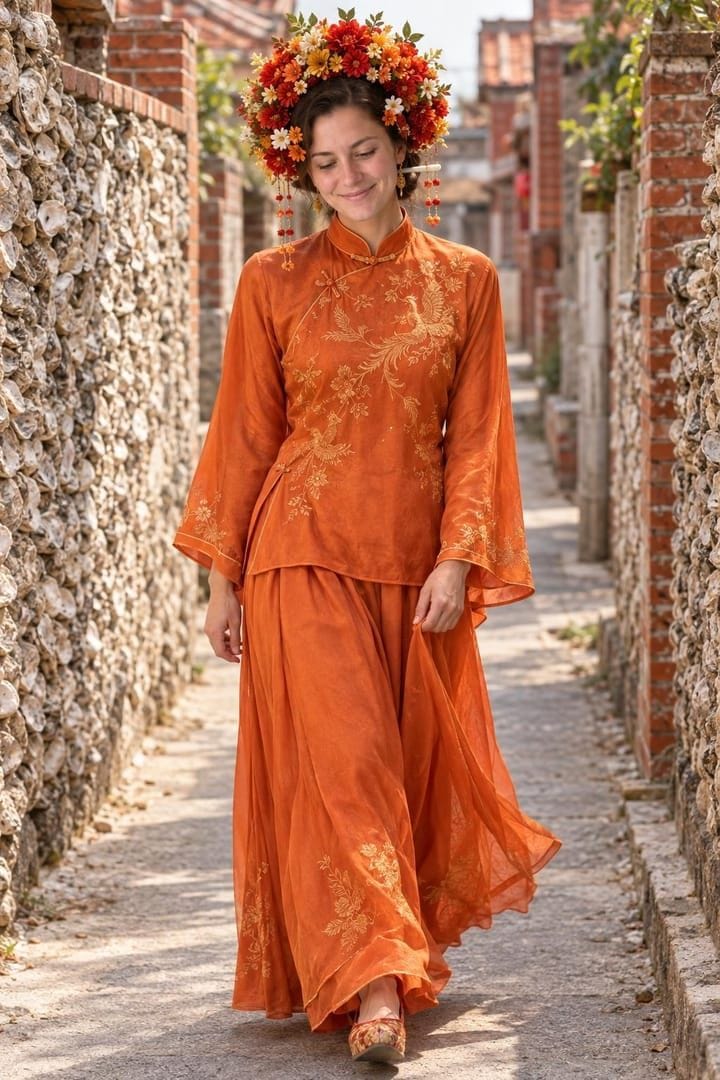
If you've seen photos of women wearing a full circle of flowers around a low bun, standing in a lane of stone walls studded with oyster shells, you've seen zanhua (簪花). It's one of the most photographed traditional looks in China right now, and it comes from one small fishing village on the coast of Fujian.
Here's the short version, then the details.
Zanhua in one paragraph: Zanhua means "pinning flowers" — wearing blossoms in the hair. In Xunpu (蟳埔), a fishing village in Quanzhou, Fujian, women turned it into the zanhuawei (簪花围, "hairpin flower garden"): a ring of flowers wrapped around a low bun and held by a horizontal hairpin. Xunpu women have worn it every day for generations, and the village's women's customs were added to China's national intangible cultural heritage list in 2008.
What does "zanhua" mean?
The word is two characters: 簪 (zān), a hairpin, and 花 (huā), flower. Used as a verb, it simply means to pin flowers into your hair.
Wearing flowers in the hair is old in China. It was especially popular in the Song dynasty (960–1279), when people of every age wore flowers, and men did too: officials wore blossoms in their caps at court banquets. Most places let the custom fade. Xunpu kept it.
Where is Xunpu?
Xunpu is a fishing village in Quanzhou, a port city in southern Fujian, about 100 km north of Xiamen. Quanzhou was one of the busiest ports of the Maritime Silk Road. Arab, Persian and Southeast Asian merchants traded there for centuries, and in 2021 the city was inscribed as a UNESCO World Heritage Site.
Xunpu sits near the mouth of the Jin River, close to the old harbour. It's known for three things: its oyster farming, its oyster-shell houses, whose walls are set with thousands of shells like fish scales, and its women's flower crowns.
What is a zanhuawei made of?
A zanhuawei has three parts:
- A low bun, coiled at the back of the head.
- A long hairpin pushed horizontally through the bun. Traditionally it was made of bone or ivory; today it's often a simpler pin.
- The flowers: strings or rings of blossoms wrapped around the bun in layers, with extra clusters on both sides of the pin.
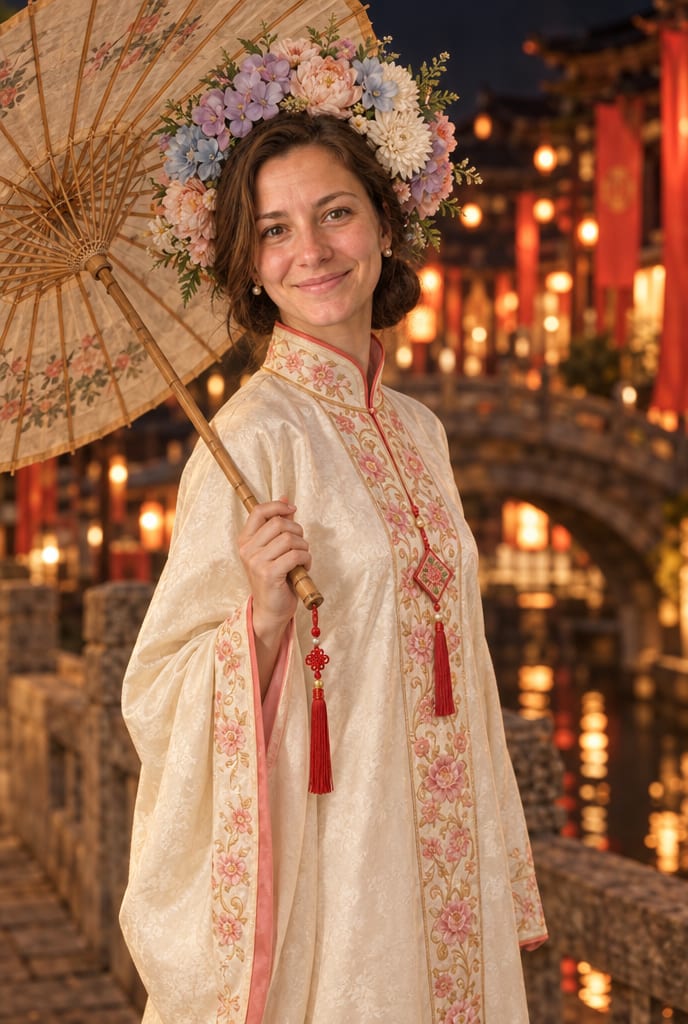
The flowers change with the season. Jasmine, magnolia-family blossoms, roses and chrysanthemums are all common, and each crown is a mix of colours, textures and sizes. In the past, when fresh flowers were hard to get, women made flower shapes from paper. Today, many crowns for visitors use silk flowers, which last all day and photograph well.
The full traditional outfit adds a side-fastening jacket with a wide lapel, loose wide-leg trousers that suit work by the water, and earrings, often a small gold drop.
Why do Xunpu women wear flowers?
There's no single answer, and locals tell it a few ways:
- Trade and travel. Many people link the custom to Quanzhou's sea trade: flowers and flower-wearing habits arrived from abroad and mixed with local traditions.
- Faith. The custom is tied to Mazu, the sea goddess who protects fishermen. Women wear their best flowers when they visit her temple, and the village holds a large procession around her festival each spring.
- Everyday beauty. For Xunpu women, the crown is simply part of getting dressed. Flowers mark a girl growing up, a wedding and old age, and folk custom says they bring health and good fortune.
All three can be true at once. It's a living custom, not a costume: many older women in the village still wear it to the market.
Why did zanhua go viral?
The village was a quiet local attraction until 2023, when a celebrity photoshoot in Xunpu dress spread across Chinese social media. Within months, hair studios opened all over the village. Today there are well over a hundred, and holiday crowds can run to tens of thousands of visitors a day.
The look has since gone international: foreign travellers post their zanhua photos, and village artisans have shown the craft abroad. It also spread beyond women. Some men now try a flower or two, much as men did in the Song dynasty.
How to wear zanhua yourself
In Quanzhou. Book a hair studio in Xunpu. Most include the crown, a costume and sometimes a photographer. A few tips:
- Go on a weekday morning. Weekends and national holidays are packed.
- Bring a top that buttons or zips. You won't want to pull anything over a finished crown.
- Take photos in the oyster-shell lanes and by the harbour, not just in the main street.
- Expect the crown to be heavier than it looks. It's built to last a day, not an hour.
At home. You can make a simple version with a low bun, a long hairpin and a ring of silk or fresh flowers wrapped around it. Start with three or four main blooms and fill the gaps with small buds.
Online. If you can't get to Fujian, you can see what the look would be like on you first.
Is it okay to wear zanhua if you're not from Xunpu?
Yes. Xunpu villagers themselves turned the crown into a welcome for visitors, and studios are happy to dress anyone. As with any traditional dress, a little respect goes a long way: learn its name and where it comes from, and don't treat it as a costume-party joke.
Quick answers
How do you pronounce zanhua? Roughly dzahn-hwah. Zanhuawei is dzahn-hwah-way.
Is zanhua the same as a flower crown? Not quite. Western flower crowns sit on top of the head like a headband. A zanhuawei wraps around a bun at the back, held by a hairpin.
Are the flowers real? In daily village life, often yes. Studio crowns for visitors are usually silk, so they last all day.
When is the best time to visit Xunpu? Spring and autumn are the most comfortable. Mazu's festival in spring is the most festive, and also the busiest.
Can men wear it? Traditionally the zanhuawei is a women's style, but flowers in men's hair have a long history in China, and some male visitors now wear a single flower or a small cluster. In Dynasty Portrait's Xunpu style, men get a chest flower, a woven fisherman's hat or no headwear.
Want more context on the look? See our Xunpu flower crown style page, or our guide to what to wear for Chinese New Year 2027.